
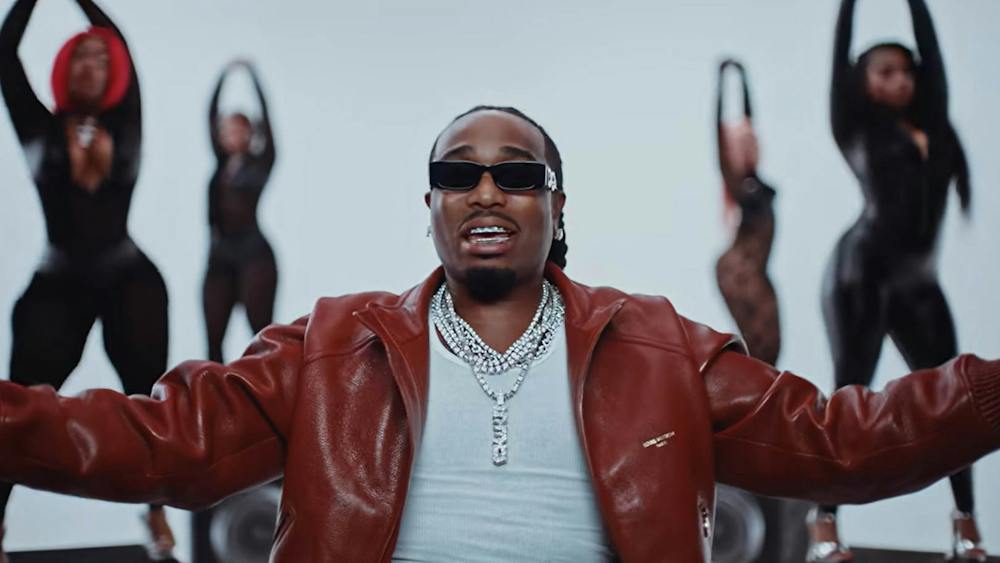
Where do you go to process your sorrow? Some retreat to a cabin in the woods. I wander around the city until my legs get tired. Quavo, meanwhile, splits his time between Louis Vuitton’s Paris headquarters and a yacht off the coast of Miami.
This tells you a lot about where his head was at on Qrömelife, the rapper’s third solo album, made with long–time producer Pharrell Williams by his side. It’s been four years since the tragic death of Takeoff, Quavo’s nephew and fellow member of Migos, and three years after Rocket Power, the album where he mourned openly. But this time around, we hear a guy who’s done grieving out loud and is scarring over his wounds with a chrome casing instead.
This “coming out Qrome,” according to the artist, means choosing not to dwell in the dark times but instead reflecting brightness onto your surroundings and refusing to stop shining. On Qrömelife, misfortune is Quavo’s muse, but he flips the feeling on its head with seriously unserious beats that force you to jump out of your seat. However, while it succeeds at its goal of luxury entertainment, those yachts still skim the shallows. The album doesn’t fully commit to an inspiration for how to cope, and at times concedes that Quavo won’t make it out of that dark tunnel until he has reached the stadiums.
He has chased this dream since the beginning of his rap career, never having headlined a stadium tour, not even with Migos. This is now the final checkbox to tick before he accepts his successes, and the pure spectacle of his new album shows that he will never let his empty venue incident from 2024 happen again. Now he is able to realize these dreams with one of rap’s greatest producers behind him, helping him grow not just as a performer but as a professional and a person too. Williams himself knows the struggle—having humble roots in Virginia Beach before becoming a triple threat in music, film, and fashion. He’s already pushed Quavo into new territory, using “HAAVIN” to open the 2027 men’s spring–summer show for Louis Vuitton, of which Williams is the men’s creative director.
The song, belonging as much in a Paris showroom as a stadium, is one of the album’s best examples of grief turned into polished shine reflecting luxury and positivity back into the world. It marries William’s signature four–count opening and bouncy synth–pop sound with a sharp beat switch that drops into Quavo’s trademark triplet–flow. This style, also known as the “Migos Flow” or “Versace Flow” took over modern rap. “BA,” the album’s second track, is a great example of this, with Future rapping in a similar cadence. But its ubiquity has also drawn criticism from older rappers like Snoop Dogg, who said on GGN Talk Show that new rappers “all … sound the same.” But Williams shows that there is a way for Quavo preserve the sound and legacy he and Takeoff built together while still moving into new commercial territory.
That tension has become harder to navigate as Quavo and Takeoff—known together as Unc & Phew—have found themselves circulating in corners of the internet far removed from their music. Their iconic appearance on A COLORS SHOW, where they performed “Hotel Lobby,” has become the subject of an AI trend, giving the duo a new wave of visibility stripping their image from the human creativity that produced it. Sure, the trend re–viralizes their names, but not out of appreciation for their music or recognition for them as individuals. Most viewers watching cats mimic the rappers’ gestures likely have little idea who they are—or that the gestures came from them in the first place. Quavo’s reaction to the trend, alongside the direction of his new album, leaves it unclear whether he minds that dehumanization. He stays true to his roots on tracks like “HAAVIN” and “BA,” but on tracks like “House Music” with Justin Timberlake, he falls right into the alluring trap of inauthentic, commercial appeal.
If Madonna brought the dance house genre back with Confessions II, Quavo and Timberlake killed it off with their vapid lyricism (“the music you buy houses with … house music house music house music”) and gimmicky crossover. The track attempts to reinvigorate that 1980s dance–floor sound, but it’s a lucrative experiment that puts the rapper’s focus on a genre he will never, and should never, break into. It’s an uninspired misfire, too clunky to be found in any club, but not appropriate for the setlist of his (hopefully soon) stadium tour.
It’s confusing to see how that track lives on the same album as “Babybreath,” a song less focused on mainstream appeal and more on pure creative intent. This song is the best argument in favor of Qrömelife as an easygoing collection of tracks that troll the audience—of course, before it hurts itself with its own exhausting wish for mainstream success. Some fans may not have appreciated the writing of “Babybreath,” especially after Tyler the Creator described his work on it as his “best verse of all time” before revealing that comment to be absolute ragebait. But hey, ChatGPT could never get even remotely close to this level of imagination, ingenuity, and irony:
“Bling, bling, bling, bling, bling, bling, bling, bling / bling, bling, bling, bling, bling, bling, bling, bitch.”
“Babybreath” would never be considered for a Louis Vuitton show, but it could have easily joined Quavo’s setlist to perform at a WWE event with excessive pyrotechnics and a shopping cart full of money (apt for this economy). The distance between a Paris runway and a wrestling ring is the album’s central tension. Williams is willing to help bring Quavo to the big stage, but they are fundamentally different artists with fundamentally different aesthetics: LV vs WWE, pop vs trap, couture vs drip. On Qrömelife, neither one wins.
In an Spotify interview with Yung Miami, featured on the playfully named “HAOYU DEWDAT,” she describes Quavo as just a “fun person,” admitting that she felt totally comfortable in the studio with him. Although, maybe some pressure could’ve encouraged Williams, Quavo, and crew to put a little more effort into the song’s production. Quavo’s limited vocal ability, a minimalist beat, and repetitive lyrics make for a bouncy but forgettable track—one that seems more interested in maximizing quantity of listeners than the quality of listening experience. Eight years after his debut album, Quavo finally has the freedom to define himself on his own terms: not just as one–third of Migos, but as the fun–loving guy who helped pioneer melodic trap. So why doesn’t he?
He’s on the other side of hard times, including his beef with Offset, the last of the Migos trio, and copes through goofy beats like the tropical “Away” where the two rappers collaborate for the first time since before Takeoff’s death. Fun was always the brand of the trio. With ad–libs, catchphrases, and crossover charm, Quavo has always sought entertainment from music both for the audience and for himself. Returning to this aesthetic is not a regression but a way home.
The worst songs on this album are those that don’t feel like the Quavo we know. He’s Unc, he’s a Migo, he’s the fun guy that likes to record his album in the middle of the ocean on a yacht for no reason. And, on a deeper level, he is a new father, a lifelong follower of Christ, and a man continuing the legacy of his late nephew. These are the real concrete pieces of evidence that show him on “the other side,” but they barely surface on the album.
He keeps those underneath the wave, choosing instead to float above them on a luxury ship. Maybe he wanted to get far enough offshore that the shadow of hardship couldn’t reach him. And any darkness that does present itself, he’ll just cover in Qrome. But still, he’s not done yet. He and Offset are working on the final Migos album, so Quavo is still working to get his footing back before he will carry Takeoff’s verses into that room. This record is more about surviving than healing, but that is a means of coping in itself. Qrömelife is at its best when Quavo trusts this, when he trusts that joy is enough.